
Walk into a modern hospital today and you may notice that healthcare is no longer driven by medical knowledge alone. Digital patient records have replaced stacks of files, wearable devices can continuously track vital signs, and intelligent software can help healthcare teams make faster decisions.
For students currently studying nursing, physiotherapy, pharmacy, paramedical sciences or allied health sciences, this change matters.
The hospital they enter after graduation may look very different from the hospital they know today. Understanding smart hospital technologies is therefore becoming an important part of preparing for a modern healthcare career.
What Is a Smart Hospital?
A smart hospital uses connected digital technologies to improve patient care, clinical decisions and everyday hospital operations.
It does not mean that technology replaces doctors, nurses or healthcare technicians. Instead, technology works alongside healthcare professionals, helping them access information, monitor patients and perform certain tasks more efficiently.
The World Health Organization’s digital health resources also highlight areas such as artificial intelligence, connected devices, health information systems and telemedicine as important parts of the changing digital health environment.
So, what might tomorrow’s healthcare students actually encounter at work?
1. Artificial Intelligence in Healthcare
Artificial Intelligence (AI) is already moving beyond being a futuristic idea.
AI-based systems can analyse large amounts of medical information and identify patterns that may help healthcare professionals with areas such as medical imaging, clinical documentation, patient monitoring and decision support.
For students, the important skill may not be learning how to build an AI system. It will be understanding how to use AI-assisted tools responsibly while keeping clinical judgement and patient safety at the centre of care.
2. Electronic Health Records
The days of searching through several paper files for a patient’s medical history are gradually disappearing in digitally enabled hospitals.
Electronic Health Records (EHRs) allow authorised healthcare professionals to access patient information such as medical history, investigation results, medications and treatment details digitally.
A nurse checking medication history, a pharmacist reviewing prescriptions or a laboratory professional updating a test result may all interact with digital health records during their careers.
That makes basic digital literacy increasingly valuable for healthcare students.
3. Internet of Medical Things (IoMT)
Imagine a patient’s heart rate, oxygen level or blood pressure being measured by a connected device and automatically made available to the care team.
That is one example of the Internet of Medical Things, or IoMT.
Connected monitors, wearable sensors and other smart medical devices can collect and transmit health information. Instead of relying only on occasional measurements, healthcare teams may be able to observe certain patient parameters more continuously.
For future healthcare professionals, understanding these devices and interpreting their information may become part of routine clinical work.
4. Robotic Technology
Robotics in healthcare goes far beyond the image of a robot performing surgery.
Different robotic systems can support rehabilitation, hospital logistics, laboratory processes and certain highly controlled medical procedures.
Physiotherapy students, for example, may increasingly encounter technology-assisted rehabilitation systems designed to support movement and recovery. Other healthcare professionals may work in environments where automated equipment handles repetitive or precision-based tasks.
The human professional, however, remains essential for judgement, communication and compassionate patient care.
5. Telemedicine and Virtual Care
A healthcare consultation no longer always requires the patient and healthcare professional to be in the same room.
Telemedicine allows certain consultations, follow-ups and healthcare services to take place remotely through digital communication.
This can be particularly useful when distance makes regular hospital visits difficult.
For tomorrow’s nurses, pharmacists, physiotherapists and allied health professionals, communicating clearly with patients through digital platforms may become another important professional skill.
6. Smart Diagnostic and Laboratory Systems
Diagnostics is another area experiencing rapid technological change.
Modern laboratories increasingly use automated systems for processing samples, managing results and improving workflow. Medical imaging is also becoming more digital, with sophisticated software supporting the way images are captured, stored and reviewed.
Students pursuing laboratory, imaging and other paramedical fields should therefore expect their careers to involve both clinical knowledge and technology.
Learning how equipment works, following quality procedures and recognising when a result requires professional attention will remain just as important as operating the technology itself.
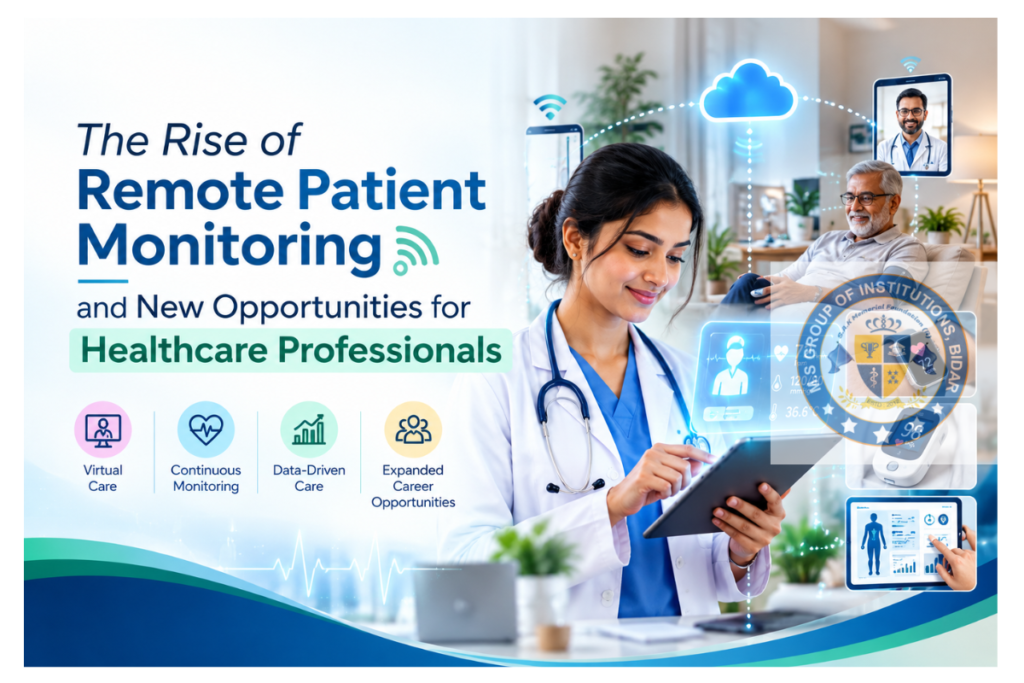
7. Remote Patient Monitoring and Wearable Devices
A patient’s care does not necessarily stop when they leave the hospital.
Wearable devices and remote monitoring technologies can collect certain health measurements outside traditional clinical settings. Depending on the system, healthcare teams may use this information to support follow-up care or monitor selected patients over time.
This is particularly relevant as healthcare moves toward more connected and continuous models of care.
Are Healthcare Students Ready for the Smart Hospital?
Technology will continue to change, but one thing is unlikely to change: healthcare needs skilled people.
A smart device can collect information, and an AI system can process data, but patients still need trained professionals who understand their condition, communicate clearly and make responsible decisions.
For students, the goal should therefore be to develop strong clinical fundamentals while becoming comfortable with digital tools.
At MS Group of Institutions, Bidar, students can explore career-oriented programs across Nursing, Physiotherapy, Pharmacy, Paramedical and Allied Health Sciences.
The healthcare professional of the future will not simply work for technology. They will learn to work with it—while keeping the patient at the heart of healthcare.