The Science of Movement: Fixing Posture and Injuries with Wearable Tech
For a long time, correcting bad posture or recovering from a physical injury relied entirely on visual observation. A physical therapist would watch you walk, or a fitness coach would simply tell you to stand up straight. Today, the approach to physical rehabilitation has completely transformed. By using data from fitness trackers and movement sensors, healthcare professionals and individuals can pinpoint the exact causes of movement dysfunctions. This modern technological leap is replacing pure guesswork with precise, real time biomechanical feedback.
Understanding the Technology: How Wearables Track Movement
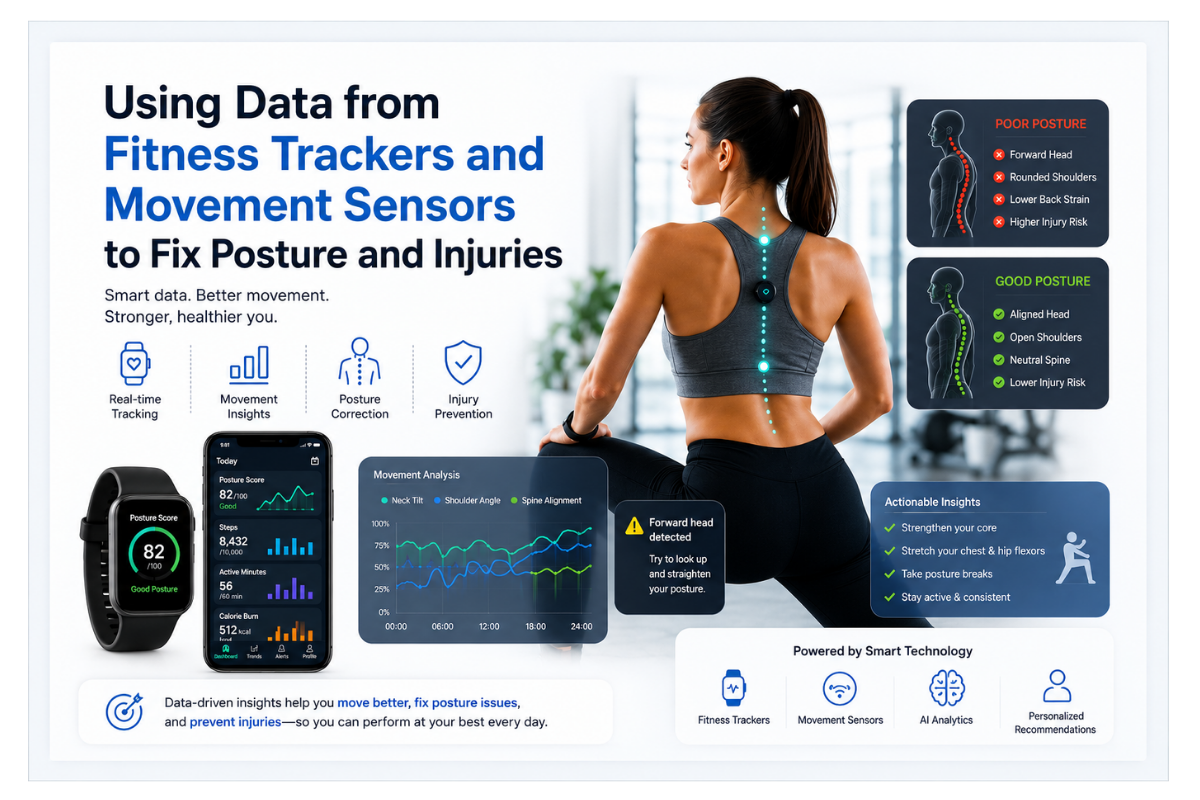
When we talk about fitness trackers and movement sensors, we are looking at highly advanced wearable technology. Modern devices are often equipped with Inertial Measurement Units, which combine accelerometers and gyroscopes to track the orientation, motion, and posture of your body in three dimensional space.
Additionally, Electromyography sensors are frequently used to measure muscle activation levels in real time. When these tiny sensors are attached to the body, they collect a continuous stream of data on joint angles, acceleration, and weight distribution. This allows clinicians and users to see micro level deviations in movement that the naked eye simply cannot catch.
Correcting Bad Posture with Real Time Data
Poor posture is a leading cause of chronic back, neck, and shoulder pain. Walking is a common daily activity that heavily involves the central nervous system in controlling posture and limb movements. By continuously monitoring your daily walking patterns and habits, wearable technology can accurately assess your overall posture and body mechanics.
For example, if you are lifting heavy items, movement sensors establish how your lifting technique impacts bodily stress and joint pressure. If you begin to slouch or shift your weight unevenly, the sensors provide immediate feedback. This allows you to remedy your form instantly, which directly helps prevent the onset of severe musculoskeletal disorders.
Revolutionizing Injury Rehabilitation
Recovering from an injury, such as a torn knee ligament or a neurological condition, is rarely a straightforward process. In traditional therapy, tiny compensations in how you move might go unnoticed, eventually leading to chronic issues or plateaus in progress.
However, wearable movement sensors allow clinicians to objectively measure body orientation and physiological state during complex movements. For injured athletes and recovering patients, these sensors serve as incredibly valuable tools during recovery by enabling clinicians to monitor joint angles, weight distribution, and range of motion. Real time metrics confirm that rehabilitation exercises are performed correctly, minimizing setbacks and ensuring safe healing.
In advanced clinical settings, this precise data is even being paired with virtual reality programs, where the therapy adapts dynamically based on exactly how the patient is moving.
Data Visualization: Making Sense of the Numbers
Raw data is ultimately useless if it cannot be easily understood. Visual representations play a crucial role in presenting biomechanical data captured by wearable sensors. These visuals enhance data interpretation by providing a clear and intuitive way to understand complex information. Through smartphone companion apps or clinical dashboards, both patients and coaches can instantly visualize this data, allowing for on the fly adjustments to form or technique.
Preparing for the Future of Healthcare
The integration of fitness trackers and movement sensors into daily health routines is rapidly changing the landscape of physical medicine. As this technology continues to evolve, the demand for educated medical professionals who understand how to interpret and apply this data is skyrocketing.
For aspiring healthcare professionals looking to master these modern therapeutic techniques, choosing the right educational foundation is essential. Students can explore industry oriented programs at MS Group of Institutions, Bidar to stay ahead in the tech driven future of clinical care. Understanding the intersection of data and human biology is the key to delivering the best possible patient outcomes.